


1. Issue Summary
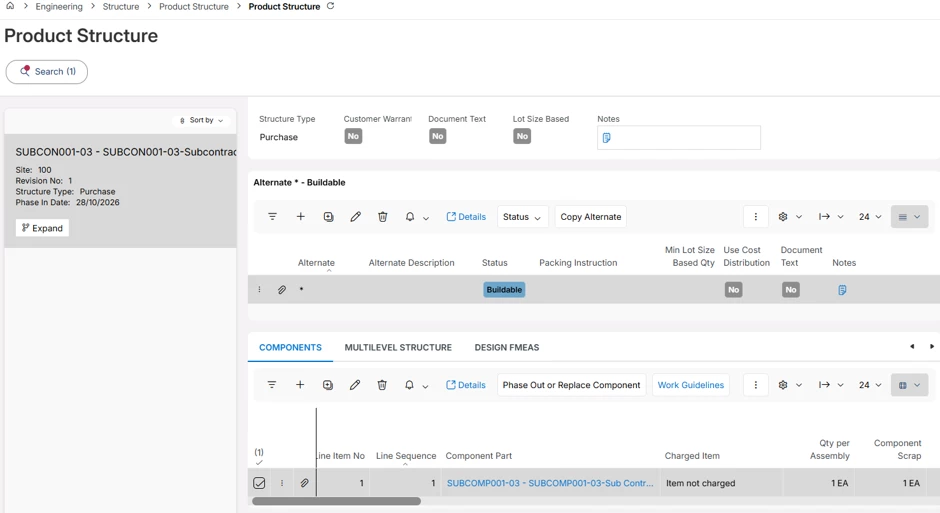
The Part Cost Calculation for Cost Set 2 appears to duplicate the sub-component cost, including its associated scrap component cost, when calculating the cost of a subcontracted main part linked to a sub-component on a Purchase type Product Structure.
As a result, the calculated Part Cost does not match the actual inventory part unit cost established through the purchase order receipt and subsequent inventory revaluation.
- Scenario Description
Our scenario involves the following parts:
- Main subcontracted part: SUBCON001-03 (Purchase)
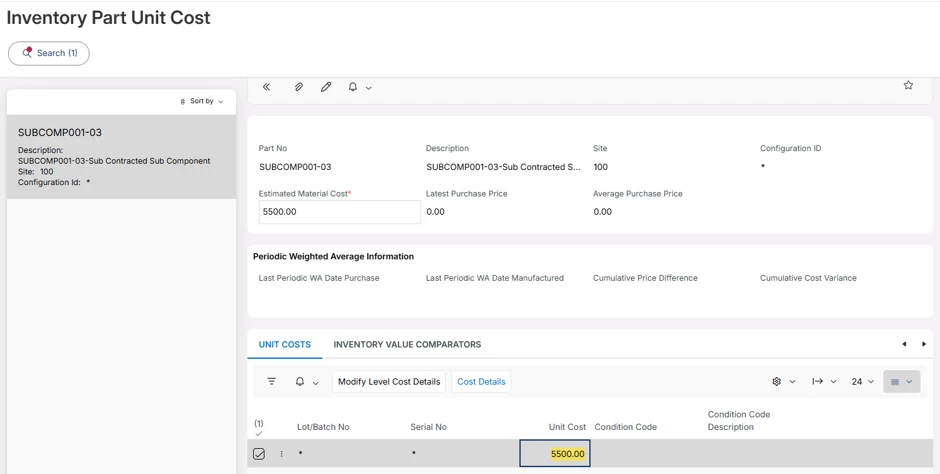
- Sub-component: SUBCOMP001-03 (Purchase raw)
- Sub-component unit cost: 5,500
- Purchase Order price for the main part: 630
The following steps were performed:
- A Purchase Order was created for the main subcontracted part, SUBCON001-03, at a purchase price of 630.
- The sub-component, SUBCOMP001-03, was shipped to the supplier for the subcontracting operation.
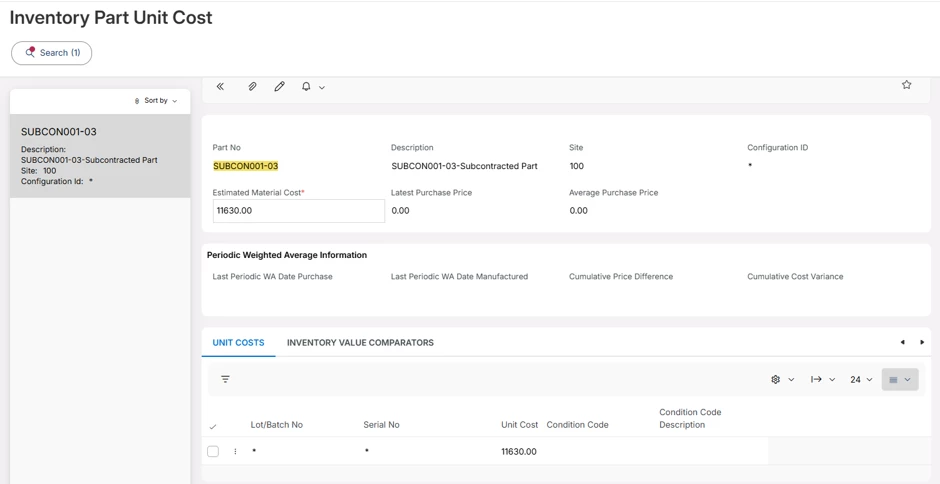
- Upon receipt of the main subcontracted part from the supplier, the inventory part SUBCON001-03 was revalued to 11,630, comprising the PO price, the sub-component cost and the component scrap cost.
- The resulting inventory part unit cost correctly reflects our intended costing approach, whereby the sub-component cost, including the relevant scrap component cost, is incorporated into the main subcontracted part's cost.
- Issue Observed During Part Cost Calculation
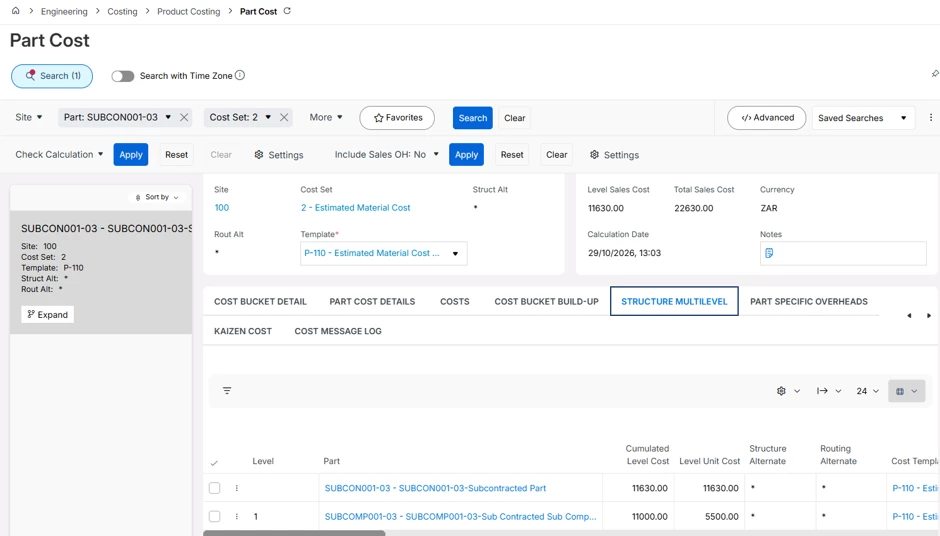
After the receipt and inventory revaluation, Part Cost Calculation was performed for Cost Set 2.
However, the resulting Part Cost for the main subcontracted part, SUBCON001-03, was 22,630, rather than the expected cost of 11,630.
The calculation appears to add the sub-component cost of 5,500 twice to the existing inventory part unit cost.
| Cost component | Amount |
| Main part inventory unit cost following PO receipt | 11,630 |
| Additional sub-component cost included in Part Cost | 5,500 |
| Additional sub-component/scrap-related cost included in Part Cost | 5,500 |
| Part Cost displayed for Cost Set 2 | 22,630 |
This results in an apparent cost duplication of 11,000.
Screenshots illustrating the Product Structure, inventory part unit cost and Part Cost Calculation results are attached for reference.
4. Expected Behaviour
The Part Cost Calculation for Cost Set 2 should correctly reflect the intended cost of the subcontracted main part without duplicating the sub-component and scrap-related costs already incorporated into its inventory valuation.
In this scenario, the expected Part Cost is 11,630, consistent with the inventory part unit cost established through the PO receipt and revaluation
5. Financial Impact
Please note that our intended business scenario is to include the sub-component cost, including the relevant scrap component cost, in the main subcontracted part's inventory valuation. Therefore , we are currently using “ Item Not Charged “ setting .
The actual financial transactions generated by the system are correct and align with this requirement. The inventory part unit cost is correctly valued at 11,630, and the actual financial transactions are correct. However, Part Cost Calculation for Cost Set 2 displays 22,630, indicating an apparent duplication of sub-component and scrap-related costs.
The issue appears to be limited to the Part Cost Calculation for Cost Set 2, which produces an inflated cost by apparently rolling up costs that have already been included in the main part's inventory valuation.
- We need clarifications on the following points: 1. Why are the sub-component cost and the associated scrap-related cost being added again during Part Cost Calculation when these costs are already reflected in the main subcontracted part's inventory unit cost?
- If we change the setting to Charged Item, the system does not roll up the sub-component cost, except for Scrap components.
However, from a financial perspective, our requirement is to retain the setting as Item not charged to ensure that the sub-component cost is correctly absorbed into the main subcontracted part. Given this requirement, what would be the alternative solution to address the Part Cost calculation discrepancy without changing the existing setting to Charged Item?
-
-
-
Apologies for the detailed post, but it was important to include all the relevant information to help the relevant members fully understand the issue and provide an appropriate solution to the challenge we are experiencing with one of our clients.
@Yathartha Karunananda I’m tagging you for visibility, as you previously assisted me with a similar post. I would appreciate your insights and guidance on this as well. Thank you!