

Question

Removal of Crystal Reports in 25R1

  • January 29, 2025
  • 73 replies
  • 8345 views

Show first post

73 replies

Forum|alt.badge.img+2
  • Do Gooder (Partner)
  • July 31, 2025

On a technical level, is it even possible for IFS to remove Crystal?

After all, Crystal is just a web service listening to incoming requests (from IFS) and responding with a PDF file.  How can they block the existing technology?

It’s one thing to de-support a product, but it’s quite another thing to actively switch it off!!


Can someone clarify?


Forum|alt.badge.img+7
  • Sidekick (Customer)
  • August 6, 2025

Has there been any updates on this topic? We are next heading to IFS 25R1 and this is a major concern when the time for 25/R2 rolls around.

Report designer is terrible. My legs can walk me forty miles also, but no one would recommend my legs as a replacement for a car.  It is a weak, user-unfriendly tool. 

Report studio seems to have a bunch of bugs and has limited functionality compared to Crystal.

Converting these reports also will solve 0.00 issues at our company. We will get the same report, we have today after spending 100s of hours converting them. 


Forum|alt.badge.img+3
  • Do Gooder (Customer)
  • August 19, 2025

Has anyone tried using the report rendering engine integration delivered in 25R1 with Crystal Report? 


darylslinn
Sidekick (Customer)
Forum|alt.badge.img+6
  • Sidekick (Customer)
  • September 3, 2025

Hello All

The deprecated log is updated 
 

IFS Cloud 24R2 Deprecation Log - Updated 20 Feb 2025


2025-02-20: This is a revised and clarified deprecation notice compared to the one that was published December 2024.

The Crystal Reports integration is being deprecated and removed from IFS Cloud.


24R2

Deprecated, integration still available, fully functional and supported.
Recommendation is to start transitioning away from Crystal Reports.


25R1
Deprecated, no longer sold, but integration still available, fully functional and supported (24 months) for upgrading customers with existing Crystal Reports licenses.
Strong recommendation to start transitioning away from Crystal Reports.


25R2

Current Crystal Reports integration no longer available


Upgrade paths are multiple. Report Studio is the tool of choice for operational report layouts in IFS Cloud moving forward. A generic report rendering engine integration is being introduced to enable integration with 3rd party rendering engines for operational reports. This is a 3rd party agnostic integration, which means it can be used to integrate any 3rd party rendering engine that is able to consume XML as input data and produce a PDF as rendered output.


For ad-hoc reporting use of Crystal Reports (i.e. Crystal Quick Reports in IFS Cloud) several different options exist. These include, but are not limited to, Lobbies / Lobby elements and Power BI using BI Analysis Models.

So with this in mind are IFS offering a tool to convert all of our Crystal Reports (over 250) to another format or do we have to spend time and money developing them all again from scratch ?
All this because of a licencing matter, out of our control…. not much thought again has been given to the end customers.


Forum|alt.badge.img+7
  • Sidekick (Customer)
  • September 3, 2025

Maybe IFS is offering to discount the annual license fees, for all of the time spent converting Crystal reports to other formats? Send the hours to IFS, and deduct from the bill? Is that how it works?


Martin Olsson
Do Gooder (Employee)
Forum|alt.badge.img+4
  • Do Gooder (Employee)
  • September 4, 2025

On a technical level, is it even possible for IFS to remove Crystal?

After all, Crystal is just a web service listening to incoming requests (from IFS) and responding with a PDF file.  How can they block the existing technology?

It’s one thing to de-support a product, but it’s quite another thing to actively switch it off!!


Can someone clarify?


Allow me to try and clarify, please.

We’re not blocking anything. What we are doing in the 25R1 release (25R2 for upgrading customers) is discontinuing /sunsetting a Crystal Reports specific integration we built decades ago. This integration has simply reached end of life.

There’s always been two parts of this integration, one for operation reports (things like invoices, purchase orders and similar, reports that are part of and triggered in a standard business flow of IFS Applications / Cloud) and another one focused on what we refer to as ad-hoc reporting or quick reports (more analytical reports, things like sales statistics and similar). Any Crystal Report based operational report layouts would be based on data assembled in a format (a tabular result set) no longer used by any of our other reporting solutions, hence dated and creates an additional maintenance overhead on top of the one for the integration itself.

After careful consideration we’ve decided to stop providing this vendor specific (Crystal Reports) integration (which had reached end-of-life from a technical standpoint) and rather provide a vendor agnostic reporting engine integration capability, in addition to our out of the box reporting solutions (out of which Report Studio is the one we will focus moving forward). This vendor agnostic reporting engine integration capability is provided through the External Reports Gateway. As this is vendor agnostic it actually requires you to implement your own integration to your preferred reporting tool. Compared to using the previous out of the box Crystal Reports this is an additional step. On the other hand it caters to a much wider audience, since it can be used to integrate any tool (which of course include Crystal Reports for someone that would like to use that).

The two (the previous Crystal Reports specific and the new vendor agnostic approach) are technically different, which likely doesn’t allow you to just reuse existing Crystal Reports layouts/reports even if you implement a Crystal Reports specific integration using the External Reports Gateway, but it might be possible to reuse quite a bit of the layout and limit the efforts to adjusting to the new XML-based data source format. We’re only providing the integration point, not the actual vendor specific integrations one might decide to implement, so it all depends on how you would chose to integrate with Crystal Reports in this example.

So quite the contrary to try and block something, we’re actually opening up for being able to integrate additional reporting tools in a better way. Crystal Reports is such a tool, but there are also multiple other ones.

Just as you say, we’ve de-supported a certain part of our product. This means we no longer include and ship it in newer version (Release Updates) of the product. To continue to include de-supported things in a new version is not really feasible and not something you would see anyone doing. Already shipped product is not affected and supported throughout its lifecycle, so for an upgrading customer, that had Crystal Reports since earlier, you could go to 25R1 (the last version that contained the vendor specific Crystal Reports integration) and be supported until early 2027 when this version goes out of support. Combined with the deprecation notice period of a year this allows a total of 3 years to adapt to transition from earlier out of the box Crystal Reports integration to something else (which may very well be Crystal Reports through the External Reports Gateway if Crystal Reports is the preference).

I hope this helps sort out any misconception of us trying to block any Crystal Reports usage, as that’s not the case at all.

Thank you,


darylslinn
Sidekick (Customer)
Forum|alt.badge.img+6
  • Sidekick (Customer)
  • September 4, 2025

On a technical level, is it even possible for IFS to remove Crystal?

After all, Crystal is just a web service listening to incoming requests (from IFS) and responding with a PDF file.  How can they block the existing technology?

It’s one thing to de-support a product, but it’s quite another thing to actively switch it off!!


Can someone clarify?


Allow me to try and clarify, please.

We’re not blocking anything. What we are doing in the 25R1 release (25R2 for upgrading customers) is discontinuing /sunsetting a Crystal Reports specific integration we built decades ago. This integration has simply reached end of life.

There’s always been two parts of this integration, one for operation reports (things like invoices, purchase orders and similar, reports that are part of and triggered in a standard business flow of IFS Applications / Cloud) and another one focused on what we refer to as ad-hoc reporting or quick reports (more analytical reports, things like sales statistics and similar). Any Crystal Report based operational report layouts would be based on data assembled in a format (a tabular result set) no longer used by any of our other reporting solutions, hence dated and creates an additional maintenance overhead on top of the one for the integration itself.

After careful consideration we’ve decided to stop providing this vendor specific (Crystal Reports) integration (which had reached end-of-life from a technical standpoint) and rather provide a vendor agnostic reporting engine integration capability, in addition to our out of the box reporting solutions (out of which Report Studio is the one we will focus moving forward). This vendor agnostic reporting engine integration capability is provided through the External Reports Gateway. As this is vendor agnostic it actually requires you to implement your own integration to your preferred reporting tool. Compared to using the previous out of the box Crystal Reports this is an additional step. On the other hand it caters to a much wider audience, since it can be used to integrate any tool (which of course include Crystal Reports for someone that would like to use that).

The two (the previous Crystal Reports specific and the new vendor agnostic approach) are technically different, which likely doesn’t allow you to just reuse existing Crystal Reports layouts/reports even if you implement a Crystal Reports specific integration using the External Reports Gateway, but it might be possible to reuse quite a bit of the layout and limit the efforts to adjusting to the new XML-based data source format. We’re only providing the integration point, not the actual vendor specific integrations one might decide to implement, so it all depends on how you would chose to integrate with Crystal Reports in this example.

So quite the contrary to try and block something, we’re actually opening up for being able to integrate additional reporting tools in a better way. Crystal Reports is such a tool, but there are also multiple other ones.

Just as you say, we’ve de-supported a certain part of our product. This means we no longer include and ship it in newer version (Release Updates) of the product. To continue to include de-supported things in a new version is not really feasible and not something you would see anyone doing. Already shipped product is not affected and supported throughout its lifecycle, so for an upgrading customer, that had Crystal Reports since earlier, you could go to 25R1 (the last version that contained the vendor specific Crystal Reports integration) and be supported until early 2027 when this version goes out of support. Combined with the deprecation notice period of a year this allows a total of 3 years to adapt to transition from earlier out of the box Crystal Reports integration to something else (which may very well be Crystal Reports through the External Reports Gateway if Crystal Reports is the preference).

I hope this helps sort out any misconception of us trying to block any Crystal Reports usage, as that’s not the case at all.

Thank you,

The solutions offered though are a backward step and not fit for purpose.
This still does nothing to assist businesses in having to write new reports in the solutions offered from scratch at cost and in time.


Forum|alt.badge.img+7
  • Sidekick (Customer)
  • September 4, 2025

“which had reached end-of-life from a technical standpoint.”

Why? This just sounds like a standard techno gibberish answer to obscure the real motivation.

We understand there are options.  But all of these options have costs associated with them, and as far as I know IFS has not offered to help absorb these costs. 


ORFJAN
Sidekick (Customer)
Forum|alt.badge.img+8
  • Sidekick (Customer)
  • September 19, 2025

Hi ​@SAGROUP ,
we have upgraded to 25R1 recently (remote deployment of IFS Cloud) and I can confirm Crystal Reports are still working as before, we have been testing the reports and they are rendered properly.
We are also using CR because of 1 feature not being available in IFS report studio today, therefore we have created case to IFS to enhance the functionality. Hopefully they can deliver before next release update. Fortunately we don’t have too many reports with CR layout but I understand concerns. 
Hope this helps.


Forum|alt.badge.img+7
  • Sidekick (Customer)
  • November 19, 2025

Any progress on this topic? 

Every member of ​@IFS Community agrees and IFS is still quit. So it means nobody knows because people who works only 2 weeks a year already did the best they could at SAKO… to promise the results partners should do … that was nice one :)


But the rest don’t be shy ​@IFS Elite Solution Experts ​@IFS Global Consulting Services ​@IFS RD Product Management ​@IFS Lyn ​@IFS User ​@IFS_Fernando ​@IFS_User999 ​@IFS-SachinBhardwaj ​@Sabine Z Claesson 

Can we have anything from IFS that we can say to the customers? Basically what I was asking before (see the points below) and what are the technical aspects to tranfer from CR to e.g. report studio. We haven’ find anything in the technical documentation.

Previous questions:

  1. version 25R1 - the date when it will be realeased and when we should update it with customers?
  2. Let’s say tha 80% of customers are using Crystal Report and are in a process of upgrade or performing implemetation so It would be nice to hand over the process of Crystal report in more smooth way then now because now we are creating reports with this tool and customer as well because he can. So what should we do now? 
  3. Is it possible to define whether there will be some time even in 25R1 to adjust it or IFS will definitely stop this product in 25R1?
  4. It might have been done a slightly different way, because we will pay maintenance fee for the 3rd party product that we will not be able to use?
  5. Did IFS somehow manage to discuss it with the Crystal Report partner that the fees will be cancelled? Or why should we pay it?

Thank you for actually responding anything helpful except for sending the note this is IFS community and we are here to help you, just to gain some delusional IFS badge.

With kind regards

Nicole Valentine

Did you ever get any answers to these important questions?


Forum|alt.badge.img+5
  • Do Gooder (Partner)
  • November 19, 2025

Hi ​@rsczerowski,

in a summary what my colleagues we found out, in:

The result is that Crystal Report will be obsolete in 25R2, so if you purchased it for your customer, write your IFS manager to:

  • stop paying for CR in future
  • in case of imlementation / upgrade to get the money back because customer will not be able to use it!

Regards

Nicole Valentine


Forum|alt.badge.img+7
  • Sidekick (Customer)
  • November 19, 2025

Report studio can be done by the customer, but it is at this point an inferior tool with many weaknesses. We are starting to use it, and at this point I see it as report designer, 2.0. This package would have been fairly decent back in 2005, but that was some 20 years ago.

Maybe instead of trend chasing the latest AI hype, IFS, should focus a little but more on tools that are a backbone of the system at any company.

The report studio layout conversion tool is incredibly weak also. Looks like that was thrown in for the sales staff, to make the claim that those can be converted automatically. Technically yes, so great talking point for the team there,  but it has failed to even properly convert the most basic report designer forms, out of the box… From IFS. It could not even handle the reminder form properly.


Forum|alt.badge.img+5
  • Do Gooder (Partner)
  • November 24, 2025

Report studio can be done by the customer, but it is at this point an inferior tool with many weaknesses. We are starting to use it, and at this point I see it as report designer, 2.0. This package would have been fairly decent back in 2005, but that was some 20 years ago.

Maybe instead of trend chasing the latest AI hype, IFS, should focus a little but more on tools that are a backbone of the system at any company.

The report studio layout conversion tool is incredibly weak also. Looks like that was thrown in for the sales staff, to make the claim that those can be converted automatically. Technically yes, so great talking point for the team there,  but it has failed to even properly convert the most basic report designer forms, out of the box… From IFS. It could not even handle the reminder form properly.

Hi If you want this meesage to get to IFS you have to use @ and add IFS and choose from various options. I am also partnert that s angry but we can put together at least summary of both tools and add what is missing, hoping they would incorporate it, if we put it on Idead wall or “shout” here how bad it is and nothing will happen ...


Forum|alt.badge.img+6
  • Author
  • Sidekick (Partner)
  • December 16, 2025

I have heard rumours now that IFS have delayed the removal of Crystal until 26R2.  It is still listed in the deprecaction log for 25r2.

However I have checked the Core files for 25.2.0 and i can see that the CRYSTL component is still included.  The tables also have the 25R2 preparation scripts for EBR.  It would not make sense to have done the work to include these if the component was being removed.

Can we have a comment from IFS on these rumours.  It would at least delay a headache for a massive number of customers.


Martin Olsson
Do Gooder (Employee)
Forum|alt.badge.img+4
  • Do Gooder (Employee)
  • December 16, 2025

An early Christmas gift for the Crystal community - yes, Crystal Reports support is being temporarily reintroduced/reinstated into IFS Cloud 25R2. It was not part of the GA release, we’re in the middle of the work of reintroducing through a Service Update (SU).

We’re not in a position yet to confirm the exact SU (it won’t be SU2, but we might be able to make SU3) - we will have to come back on the exact SU.

The Crystal support will remain in 26R1 and then be removed in 26R2. This revised timeline gives everyone an additional year to transition off Crystal, it also provides an IFS Cloud version (26R1) where you will have both Crystal Support, the IFS QuickSight report functionality, plus layouts in Report Studio format for standard operational reports in the same version to enable side-by-side development/verification.

This does not mean the current Crystal Reports integration isn’t going away, so the transition still needs to be made, but it gives everyone a total of 2 + 2 years (time from deprecation announcement until removal + 24 months of support) to make the transition compared to the earlier 1 + 2 years.


Forum|alt.badge.img+1
  • Do Gooder (Partner)
  • January 8, 2026

An early Christmas gift for the Crystal community - yes, Crystal Reports support is being temporarily reintroduced/reinstated into IFS Cloud 25R2. It was not part of the GA release, we’re in the middle of the work of reintroducing through a Service Update (SU).

We’re not in a position yet to confirm the exact SU (it won’t be SU2, but we might be able to make SU3) - we will have to come back on the exact SU.

The Crystal support will remain in 26R1 and then be removed in 26R2. This revised timeline gives everyone an additional year to transition off Crystal, it also provides an IFS Cloud version (26R1) where you will have both Crystal Support, the IFS QuickSight report functionality, plus layouts in Report Studio format for standard operational reports in the same version to enable side-by-side development/verification.

This does not mean the current Crystal Reports integration isn’t going away, so the transition still needs to be made, but it gives everyone a total of 2 + 2 years (time from deprecation announcement until removal + 24 months of support) to make the transition compared to the earlier 1 + 2 years.

Thank You Martin, It is really appreciated in our project, in the energy sector. It will certainly be used!


Forum|alt.badge.img+12
  • Hero (Customer)
  • January 17, 2026

An early Christmas gift for the Crystal community - yes, Crystal Reports support is being temporarily reintroduced/reinstated into IFS Cloud 25R2. It was not part of the GA release, we’re in the middle of the work of reintroducing through a Service Update (SU).

We’re not in a position yet to confirm the exact SU (it won’t be SU2, but we might be able to make SU3) - we will have to come back on the exact SU.

The Crystal support will remain in 26R1 and then be removed in 26R2. This revised timeline gives everyone an additional year to transition off Crystal, it also provides an IFS Cloud version (26R1) where you will have both Crystal Support, the IFS QuickSight report functionality, plus layouts in Report Studio format for standard operational reports in the same version to enable side-by-side development/verification.

This does not mean the current Crystal Reports integration isn’t going away, so the transition still needs to be made, but it gives everyone a total of 2 + 2 years (time from deprecation announcement until removal + 24 months of support) to make the transition compared to the earlier 1 + 2 years.


Sorry, thanks for the confirmation Martin, but can you clarify how that would work with the 25R2 EBR Changes?

https://docs.ifs.com/techdocs/25r2/060_development/025_operational_reporting/230_ebr_preparations_reporting/#overview


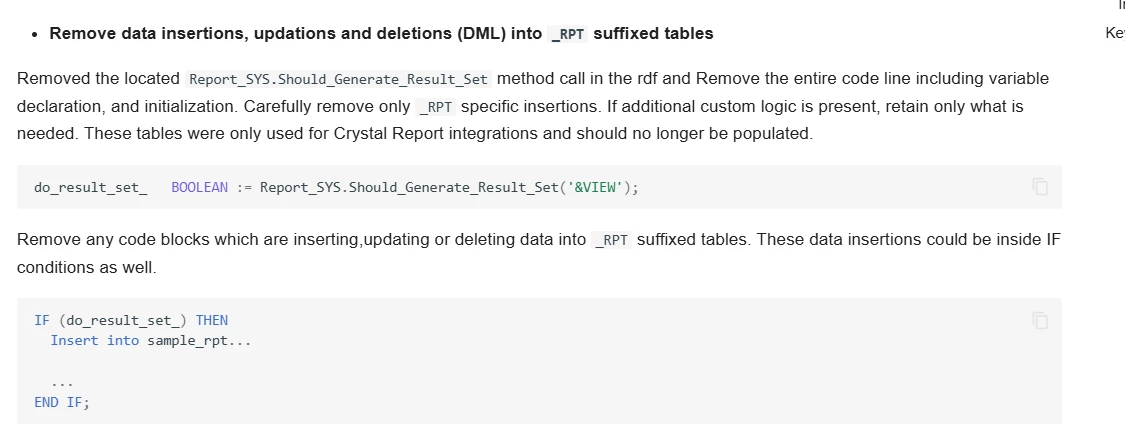
All Operational Reports were made 25R2 compliant meaning the RDF Files no longer write to any _RPT table, i.e. they don’t create any result set accessible from the associated _REP views. (whether INFO_SERVICES or any of the other dedicated _RPT Result Set Tables)


So it’s all well and good that we can have a Crystal integration back in working condition, but what views are we supposed to query to get the actual result set data to display in the reports then ?


I can confirm that for instance, in my 25R2 instance right now, if I print something that previously definitely had a result set, those result sets no longer get created in the database, and the RPI package has been changed to no longer include any of the INSERT INTO statements.
 

Or does the work RnD doing to reactivate Crystal support include changing all Operational Reports back to having some sort of result set data creation, in an EBR compliant way?
 

If re-activating Crystal Support does not include such work, then it’s probably not very useful as I’m sure most people here use those _REP views to query from Crystal, so most of our reports would no longer output any data anyways ?


Martin Olsson
Do Gooder (Employee)
Forum|alt.badge.img+4
  • Do Gooder (Employee)
  • January 19, 2026

Yes, Simon, the result sets will be brought back for this purpose, yes.

But there will be a limitation in terms of compatibility between the Delivery Continuity (aka EBR) and the Crystal Reports integration, meaning one cannot use Delivery Continuity until moved off Crystal.


Forum|alt.badge.img+12
  • Hero (Customer)
  • January 19, 2026

Excellent news; I am not a delivery continuity customer so I won’t be affected which is great, but I’m hoping then the installer won’t recognize these result _RPT tables and stop my installation because they exist and are not EBR compliant!

Does that mean that the plan is to remove the result set creation in 26R2 when Crystal gets re-deprecated ?

It’d be good to be able to keep result sets even in 26R2 EVEN IF Crystal is deprecated, for any other reasons that it might be nice to keep persistent result set data, but I understand it might not be realistic/possible or even wanted by the RnD team. 

Let’s just say right now that as a customer, I would consider having persistent result sets to be worth more to our business than having Delivery Continuity online delivery options, so I know which choice I’d make if I was offered it. 


Martin Olsson
Do Gooder (Employee)
Forum|alt.badge.img+4
  • Do Gooder (Employee)
  • January 19, 2026

Correct - there will be (or is rather) already an exception / whitelist for this, so the installed won’t complain about these result tables.

We haven’t actually removed the tables (don’t like to remove existing business data). What we did was to remove the code that created additional result set. This is what we’re now putting back in.

In 26R2 we would again look to remove the result set creating logic in the RDFs (it might be left for a bit, but will essentially be dead code). The result set tables on the other hand we will likely not delete/remove by default as the contain historical business data (so more a decision for you as a customer to decide when you’d like to remove).

Out of curiosity, why would you like result sets to keep being generated once Crystal is removed? Are you using these result sets for anything else?


Forum|alt.badge.img+12
  • Hero (Customer)
  • January 20, 2026

Hey ​@Martin Olsson ,


Thank you so much for the detailed technical clarification.


Without getting too in-depth, there are several reasons for a customer to want to retain persistent result sets, none are necessarily showstoppers and a lot of them really come down to XML being uneasy to work with directly in SQL.


XML CLOBs currently stored in xml_report_data_rtb is certainly useful and persistent to have, but is certainly not at all straight forward to query or perform analytics on.


In my company for example there are currently a few Quick Reports that are based on REP views specifically because the requirement is to print the exact result set as it was when the report was generated (typically through a schedule at like 1AM), with some additional fields not retrieved by the main RDF added through usual query artifacts (joins, API Gets, etc). I think an example of this is the Shop Order WIP Report that they generate for Month End processes, and where they need to capture the result set exactly as it was at the beginning of the month.


A few of your partners offer Crystal Integration services that plan to keep the ability for customers to use Crystal once you re-deprecate it in 26R2, but obviously that would really be of very limited usability without populated result sets to read from. (I can tell you more about that in private if you require)


Please don’t get me wrong, Delivery Continuity is a great new addition, and I’d prefer being able to have the RDF architecture reworked so that the tables it uses are EBR Compliant, but I understand this might not be something RnD is keen to invest effort in doing if the future is purely about XML sets.

This might be a stupid question but is not possible to lets say create an RDF file that writes result data into a normal (EBR Compliant) entity table dedicated to storing that report’s results ? I’m not sure what the order of installation is for Report files, and so whether there might be sequencing issues when trying to make them interact with other entities.


With the Result Set Logic being re-enabled “for now” at least, do you mind sharing if you guys believe you’re still on track for SU3 or if that’s looking less and less likely?


Martin Olsson
Do Gooder (Employee)
Forum|alt.badge.img+4
  • Do Gooder (Employee)
  • January 20, 2026

Thank you for the examples Simon, will keep this in mind when discussing the future of the result sets.

We’re not able to confirm SU3 just yet. We’re still working towards this target, but it’s going to be tight, would hopefully have a better view in another week or so.


Michael Kaiser
Sidekick (Customer)
Forum|alt.badge.img+9
  • Sidekick (Customer)
  • January 23, 2026

Wow!
I just scanned the post and realized that the Crystal Reports - IFS “connection” and its “live time” concerns a huge amount of people.

I’m doing BI projects since 1999. From 1999 to 2001 I worked for IFS germany.
In these days COGNOS (series 7) was THE master player in the BI market.
Microsoft was not realy seen, perhaps some jerks using Access databases and Excel to workaround COGNOS.

When I left IFS germany from 2001 to 2002 I still have done some IFS based COGNOS projects.
From 2002 I did a lot of JDE - and Navision/Axapa - based BI projects.
In these days we had a tool called Q4bis and an ETL tool called DataServer.
The names within 15 years changed to Halo Prism and Halo Source.
The former owner (a german guy in New Zealand) selled the company and software to Logility Inc.
They no longer support this tools. 
Given installation does have the problem that the ETL is only running on SQL Server 2018!

Since 2018 I’m back in the IFS saddle again and working with plain MS SQL. 
(the first year “crying” because my ETL tool was not available any more but now very happy because that forced me into creating my own tools!)

What I learned in more than 25 years:
Former market leader (like COGNOS) will vanish.
Frontend - tools like (Cognos) PowerPlay, QlickView, Crystal Reports, MS Reporting Services, even MS PowerBI could vanish as well.

What will stay?

The need of transparency.
Transparency to make quick decisions.

Therefore most companies have the urge to “sum up” their ERP data in meaningful reports.

And after all it does not matter, if this report is done by Excel or all these other front end tools.

BUT:
As you can see (COGNOS, Q4bis, and many more front ends) the “old stuff” could be no longer available in the future.

Conclusion: 
Stay vendor and product independant as long and as much as possible!

If these (concerning) customers would have a datawarehouse (DWH) and an ETL - process, so a daily copy of their ERP data (even better Microsoft cubes (the old multidimensional ones!)) will be a reliable base for ANY front end. 
 

The moment IFS decides not to support CR any longer they can rapidly change and use other tools.

And not only one but 2 or 3 alternatives.

On of my customer use Excel pivot (with the cubes). 
Qlick View as the main front end but since a year started to build up MS PowerBI knowledge.

So the moment Qlick is increasing price to much they can easily swap to PowerBI (or other tool).

At the end I like to say:
This all is my opinion and I’m quite shure that there are good reasons to go other ways or have other (BI) strategies. 
I’m very open to discussion and looking forward to hear from you.

All the best and good luck with your Crystal Reports.


Michael