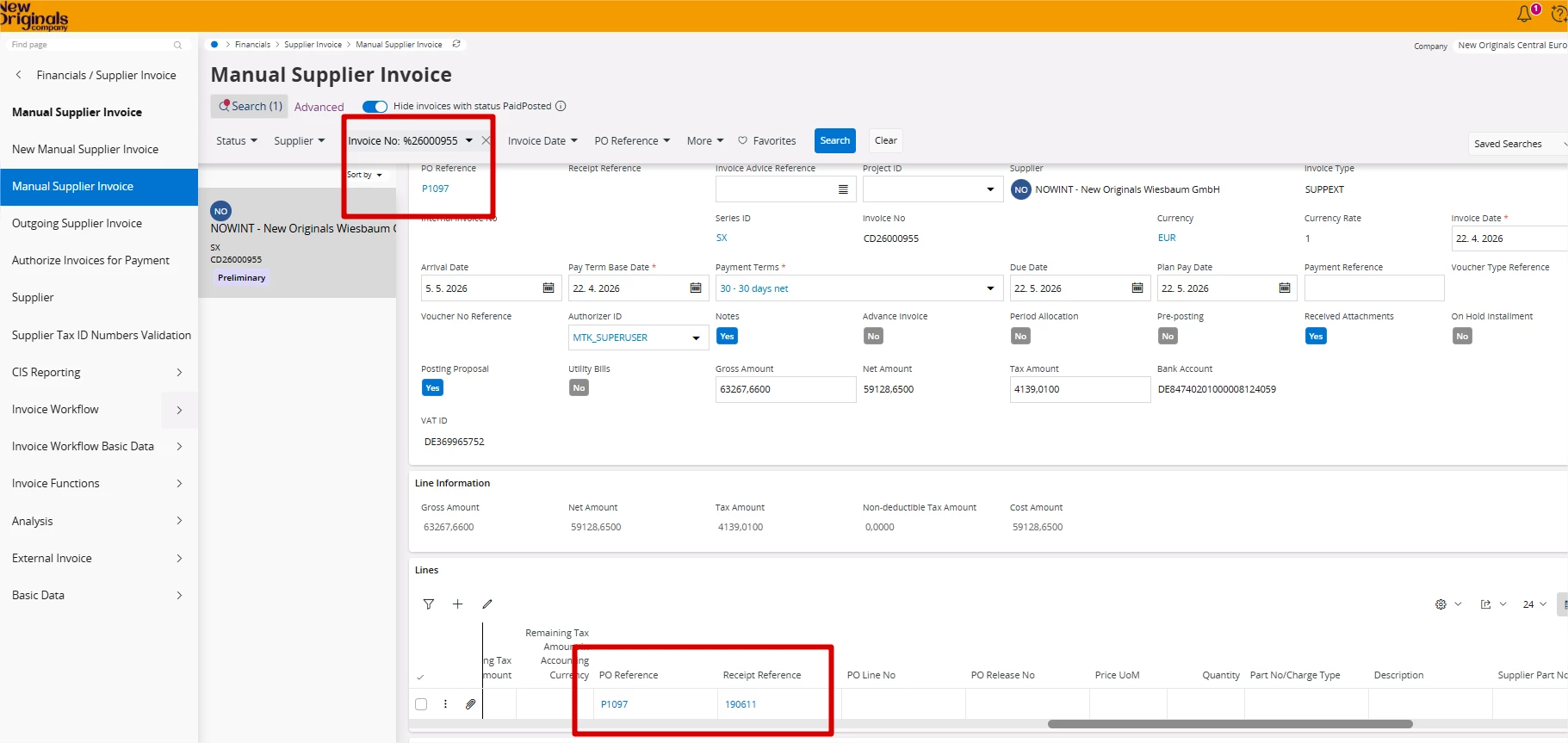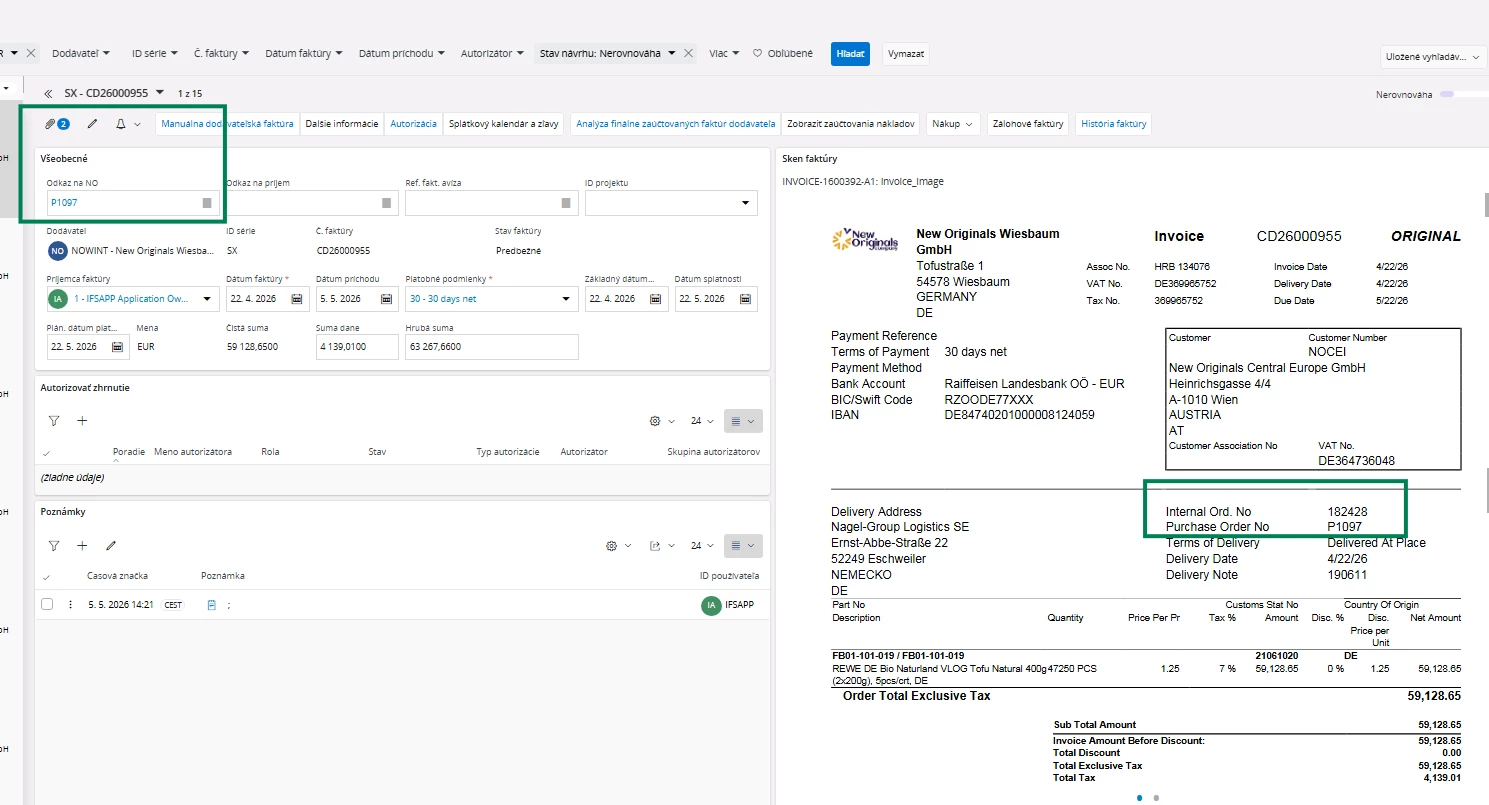


Question

Automatic Matching and Posting of Supplier Invoices for Multiple Receipts on a Single PO

  • May 27, 2026
  • 2 replies
  • 70 views

Forum|alt.badge.img+1

Hello,


We are currently reviewing a supplier invoice matching scenario in IFS Cloud and would appreciate recommendations regarding the most suitable matching setup.

Current scenario:

One Purchase Order: PO P1097
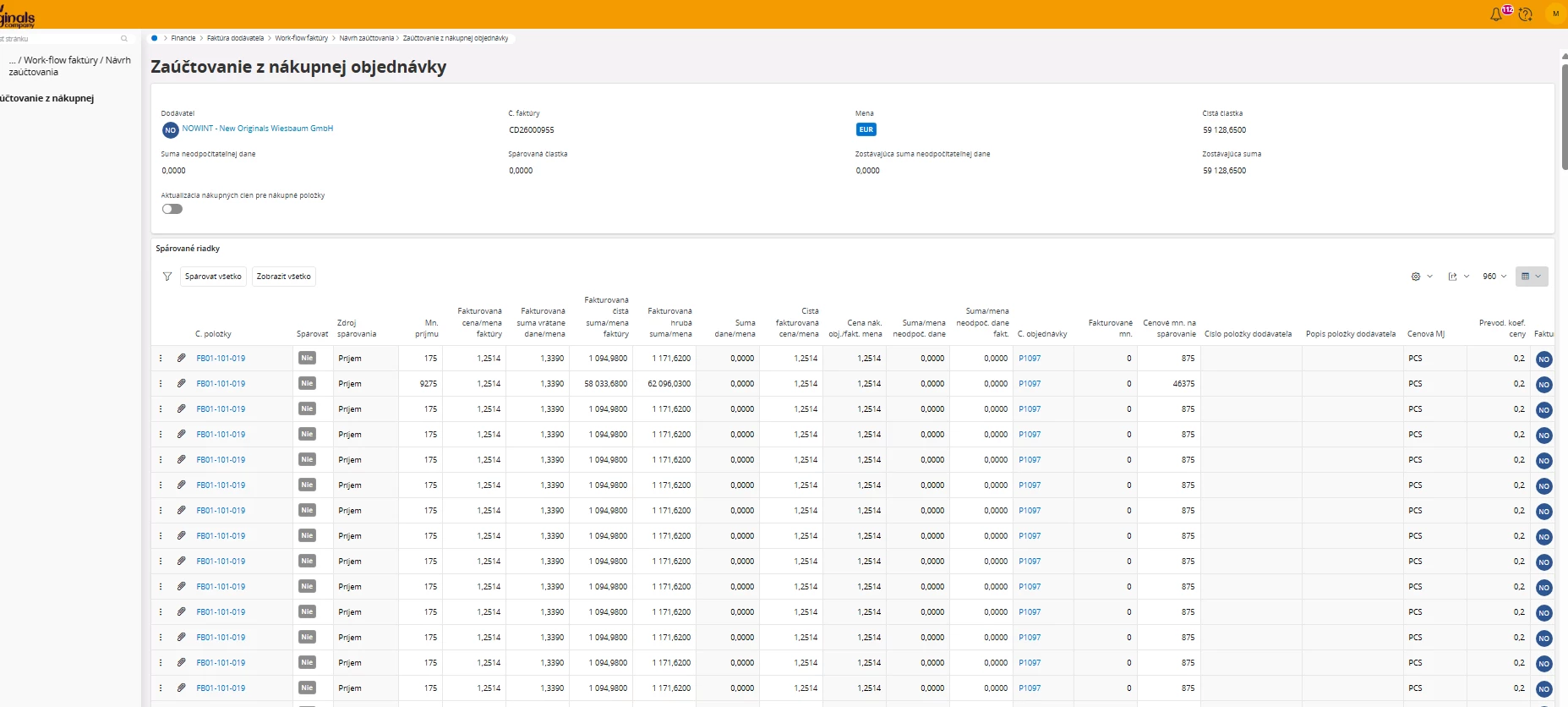
Approximately 172 PO lines
Multiple receipts created against the same PO
Multiple supplier invoices are received gradually against the same PO
Each supplier invoice represents only a subset of the delivered receipts/items
Example:

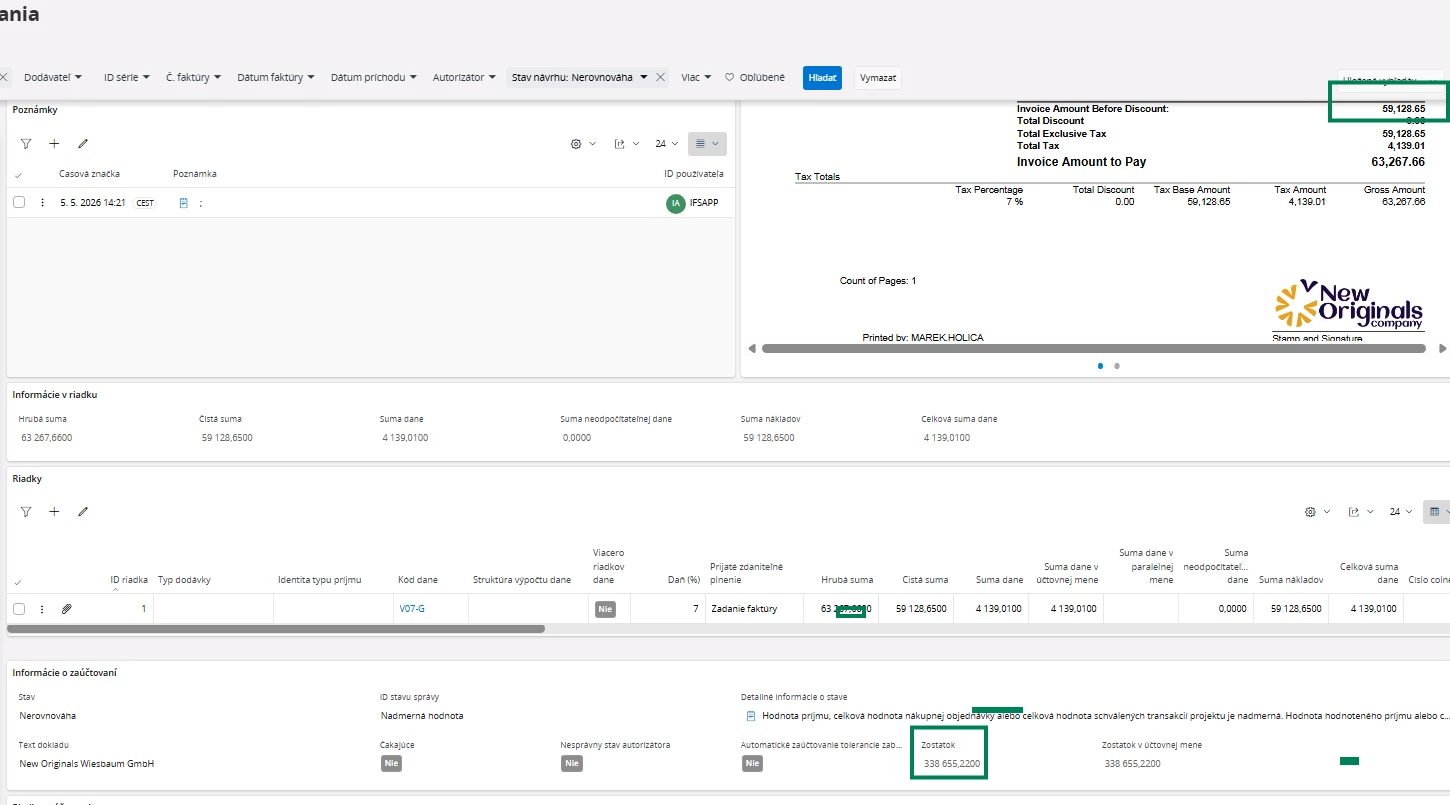
Total received amount on PO: 338,655.22 EUR
Supplier invoice amount: 59,128.65 EUR
Around 15 supplier invoices are expected for the same PO

The issue is that during supplier invoice matching, users retrieve a large number of receipt lines and cannot easily identify which receipts belong to a particular invoice. 


Questions:

Which matching option would you recommend for this scenario?
Has anyone implemented a similar process with multiple receipts and multiple invoices against a single PO?
Is Receipt Reference considered the preferred approach in such cases?

Are there any additional PO Matching settings or best practices that could improve automatic matching and reduce manual work?

Our goal is to minimize manual effort and simplify invoice processing for accounting users.


Thank you in advance for any recommendations.

2 replies

Forum|alt.badge.img+20

Hi, 

I see two options, 

  1. Use the PO receipt reference for the matching criteria.   This works very well for your scenario if the following is also true. Upon receiving enter a receipt reference for example PACK1 (packing slip 1). The invoice them must also reference that packing slip 1 on the invoice, so when entering in IFS we match the goods received for PACK 1 with that invoice.  Often this receipt reference - making sure the appropriate value is entered at receiving as well as invoice entry.  Many large suppliers will include some reference on the invoice that matches what they used within a flavor of delivery note.  
  2. If the supplier and your organization have a very close relationship / we trust the price on the PO, we trust that the goods are correctly received, it could be possible to turn on self-billing for that supplier.  Self-billing automaticity creates the supplier invoice and matches this with the receipts.  But you only want to use this when you trust the PO price and quantity received. That usually only happens when you have a very good relationship with that supplier, and when the material on the PO is fairly stable (not configured where price changes based on any number of factors). Bottom line you must have valid PO price. 

Best regards, 

Thomas


Forum|alt.badge.img+1
  • Author
  • Do Gooder (Partner)
  • June 4, 2026

Hi Thomas,

Thank you for your detailed explanation.

The first option seems particularly interesting for our scenario. Currently, we have situations where a single PO can contain a large number of receipt lines and multiple supplier invoices are received gradually against the same PO. This creates a challenge for accounting users when matching invoices to the correct receipts.

Based on your explanation, it seems that using the Receipt Reference as a common identifier between the receipt and the supplier invoice could significantly reduce the number of candidate receipts and improve the matching process. I especially like the fact that the same reference can be used both during receipt entry and invoice registration.

I will review our current process in more detail and verify what information is available at the time of receipt. We will also test whether a meaningful reference can be consistently entered during receipt registration and later used during invoice matching.

The self-billing option is also interesting, but at first glance it appears less suitable for our current business process. Therefore, I would like to focus on the first approach and evaluate whether it can help us achieve a higher level of automation without changing the overall process significantly.

Thank you again for your suggestions.

Best regards, 

Slavomira