



Question

Rental Assets moving - Inter company flows - Ownership does not transfer to Supply site

  • May 5, 2026
  • 3 replies
  • 33 views

Chamath Kuruppuarachchi
Hero (Partner)
Forum|alt.badge.img+13

Hi All,

I am running a flow on a situation where company A is purching a rental asset from the company B. In that case in the Company A there is a PO in the part lines tab to purchase the asset with the ownership “Company Rental Asset”.
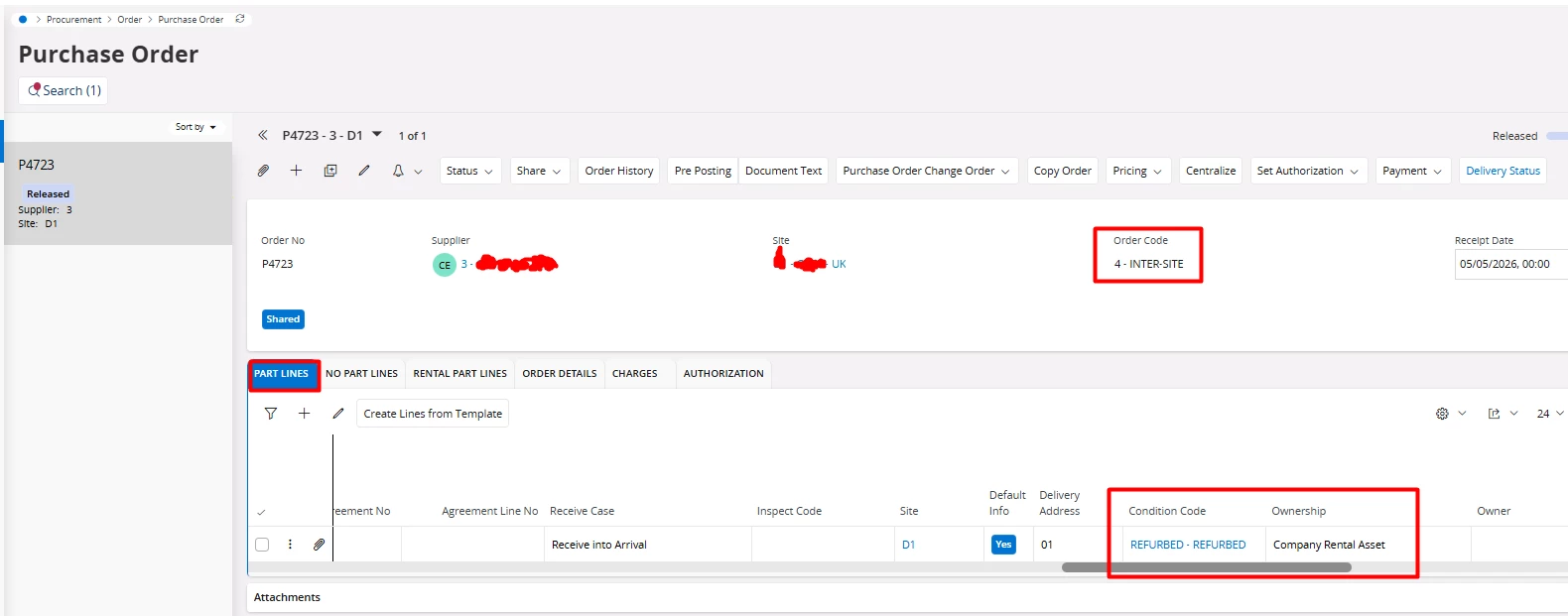
Upon releasing and sending the PO. Inter company CO is getting created in the supply site which is Company B in my example.

But this Customer order line state the ownership “Company Owned” not “Company Rental Assets”. If the demand is coming from “Company Rental Asset” then the supply should also be in “Company Rental Asset” is it? Seems other line data is coming from the interco PO line but not the ownership. 
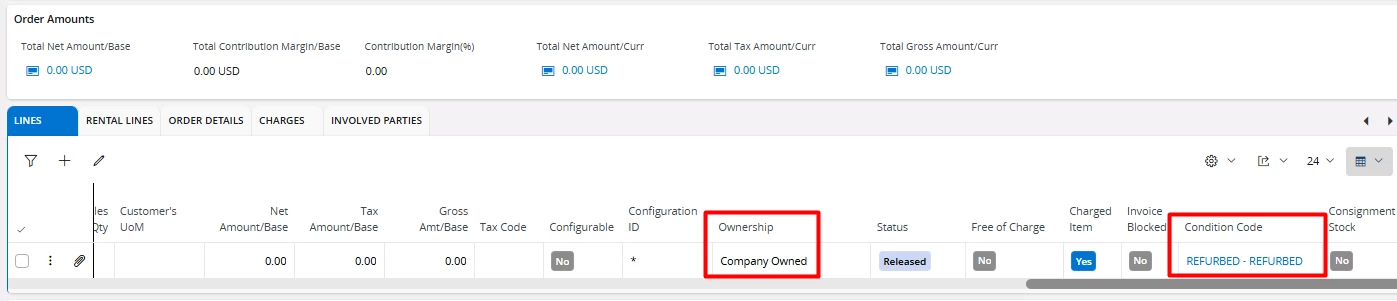
Is there a setting known to anyone to control this behaviour. I have set up the sales part as “Sales and Rental” in the Company B. 

3 replies

Piyal Perera
Hero (Employee)
Forum|alt.badge.img+12
  • Hero (Employee)
  • May 8, 2026

Hi ​@Chamath Kuruppuarachchi,

   I chat with cursor and feel that got a satisfactory answer that I also can agree.

***

From a business angle, it is reasonable to want the supply side (Company B’s intercompany customer order) to carry the same ownership notion as the demand side (Company A’s PO with Company Rental Asset), when you are moving the same asset between related companies.

In IFS, intercompany supply is not implemented as “mirror whatever ownership the buyer had.” It follows fixed rules on the purchase order when it becomes an internal/intercompany order (order code 4), and the intercompany customer order line then copies ownership from the PO line after those rules have run.

What actually happens in this repository

1. On PO release (internal supplier → order code 4), the code can change part ownership to Company Owned on the PO line unless an exception applies:

So Company Rental Asset is only left on the PO line in this intercompany situation when all of the following hold:

  • Buyer and supplier are different companies (inter_company_),
  • Ownership is Company Rental Asset or Consignment,
  • Demand on the line is Inventory order (IO) or Distribution order (DO),
  • And the line is not flagged as rental on the PO (rental = FALSE is required to even enter this “maybe force Company Owned” path).

If your line uses another demand type (for example No demand (NO) on a straightforward buy, or pegging that is not IO/DO), the release step sets ownership to Company Owned on the PO. The user-facing info message in the same block explains that only certain ownerships are allowed for internal/direct deliveries.

2. Intercompany customer order lines take ownership from the purchase order line at creation:

So if the PO line was already turned into Company Owned on release, Company B’s CO line will correctly show Company Owned—it is consistent with the PO after processing, not with your original “rental asset” intent alone.


Chamath Kuruppuarachchi
Hero (Partner)
Forum|alt.badge.img+13

Hi ​@Piyal Perera 

Hi Piyal,

Thank you for the information provided. However, I disagree with the explanation, as the current system behavior does not align with how rental businesses operate in real world scenarios. Allow me to explain this in more detail.

As we know, rental assets are not automatically planned, and many customers rely on custom pages and reports to obtain the required operational data. The current flow creates a significant risk of misleading or inaccurate data interpretation.

In businesses operating large rental fleets movement of rental assets between sites is a very common scenario. When the demand site requests a “Company Rental Asset,” the supplying site should also reflect that the demand is specifically for a “Company Rental Asset,” rather than “Company Owned.” 

The negative impact of the current behavior is high. Since the system does not convert the ownership correctly, IFS interprets the transaction as a demand and proceeds with planning, automatically creating purchase requisitions. This creates unnecessary supplies and additional workload for buyers. From a business perspective, generating new PR for existing company rental assets is not acceptable.

For companies managing large rental operations, such as ours with more than 8,000 rental assets, it is simply not practical to manually validate ownership on every CO line associated with intercompany orders.

I am surprised that IFS does not consider this in the intercompany flow, particularly when the Rental Module is being used. While I understand the issue may not originate directly within the Rental Module itself, customers invest in this module specifically to support rental asset movement processes. Given that Distribution Orders also do not properly handle company rental assets, this functionality becomes even more critical.

Ideally, since CO lines already inherit condition code values, they should also inherit the correct ownership type especially in environments where the Rental Module has been implemented.

I intend to raise this formally with IFS through a support ticket, as I would like to receive an official response regarding this behavior. From the perspective of a large scale rental business, this appears to be a fundamental operational requirement that the system should support.


Thanks,

Chamath


Piyal Perera
Hero (Employee)
Forum|alt.badge.img+12
  • Hero (Employee)
  • May 11, 2026

Hi ​@Chamath Kuruppuarachchi 

  Yes. Please raise a support ticket that can pave way for more discussions.

regards,

Piyal