


Question

Purchasing leadtime vs expected leadtime

  • January 26, 2026
  • 2 replies
  • 31 views

Forum|alt.badge.img+2

Hello, 

A question: We have a case where the expected leadtime affects for our planners. Should it really be 30 days in between purchasing LT and expected LT? Thats seems a lot. 

I know in purchasing LT involves/includes: Supplier Manufacturing Lead Time, External Transport Lead Time, Internal Transport Lead Time, Internal Inspection Lead Time. But which leadtimes includes in the expected leadtime? is it something internal at the production and not for me a as purchaser to set? Which LTs includes in the expected leadtime?
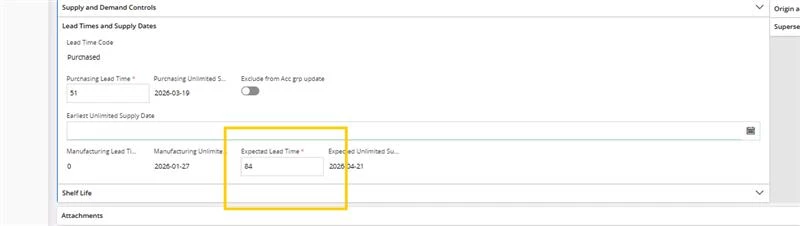
I have seen this a lot on articles. We tryna minimize it is our materials that sets the leadtime for our products. 

2 replies

Yathartha Karunananda
Hero (Employee)
Forum|alt.badge.img+11

Hi ​@Vallin98,

Did you check this? I hope you can understand this from here:
Manufacturing lead time and expected lead time | IFS Community


Forum|alt.badge.img+12
  • Hero (Partner)
  • January 26, 2026

Are you using the Inventory Planning and Replenishment (IPR) functionality?  If not, your Planners shouldn’t be affected by this value.  

The Expected Lead Time is usually used as an extension of your lead time from a Customer Order perspective. 

For example, for Part A:

Purchased Lead Time: 10 Days

Expected Lead Time: 12 Days (this may account for unexpected delays or act as a buffer that you deem to be realistic).  

The above indicates that although it may take you 10 days to receive the part, you will acknowledge to the customer (when using Availability Check) 12 days to reduce the likelihood of the order being delivered late.