


Dear Community,
Summary
Please enable IBAN validation also for ISO20022 to increase financial data integrity, strengthen the overall financial solution, and mitigate the risk of time‑consuming errors. This issue has been reproduced in 24R2 as well as in 25R1.
Description
The window “IBAN Validation Information” in IFS Cloud allows users to add an additional security layer to IBANs, which are highly sensitive financial data. The original purpose of this feature is that whenever an IBAN is entered in the system, it is validated against the parameters maintained in this window. This ensures that only valid bank accounts are stored in IFS.
This currently works, for example, with SEPA payments. When a supplier payment address is created with payment method “SEPA”, the IBAN is checked accordingly and faulty entries are immediately identified and rejected:
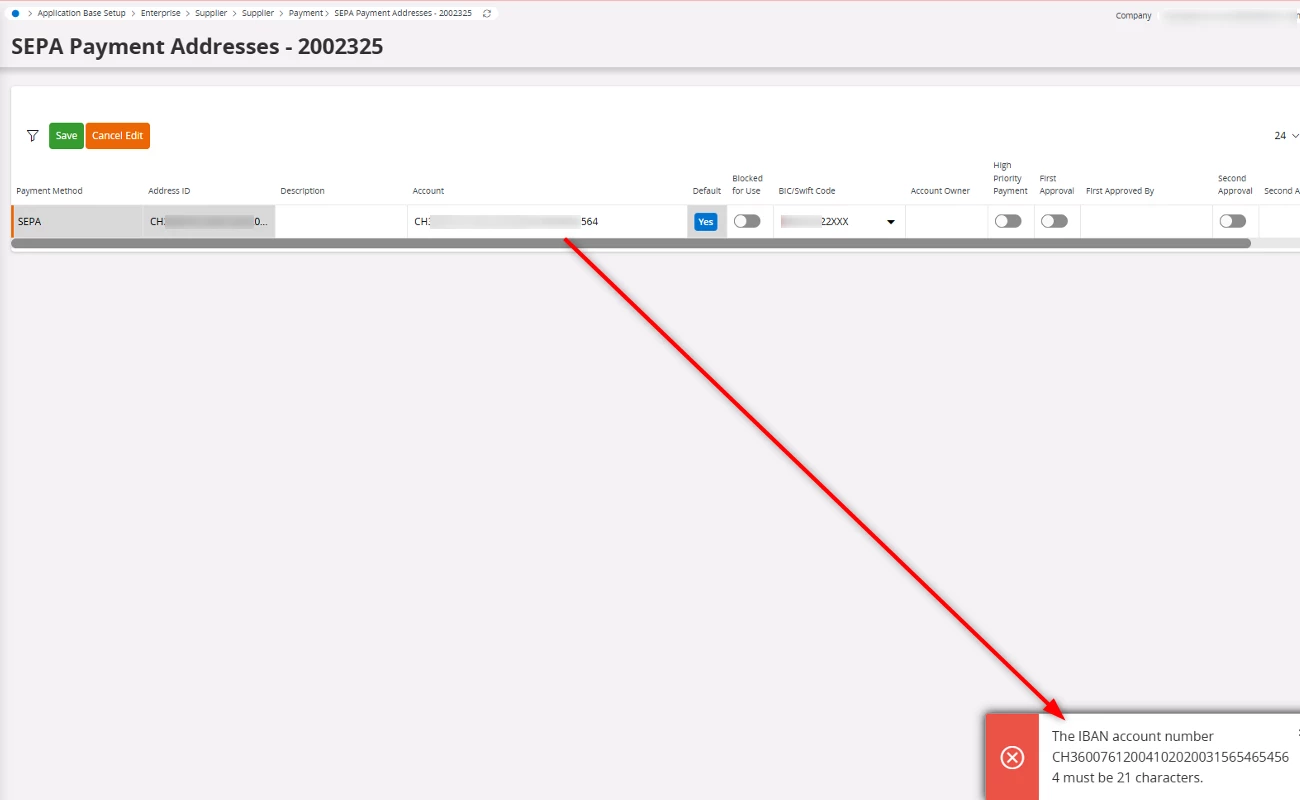
However, when adding an ISO20022 payment address, no IBAN validation is performed. This leads to situations where clearly incorrect IBANs can be added and saved without error/warning:
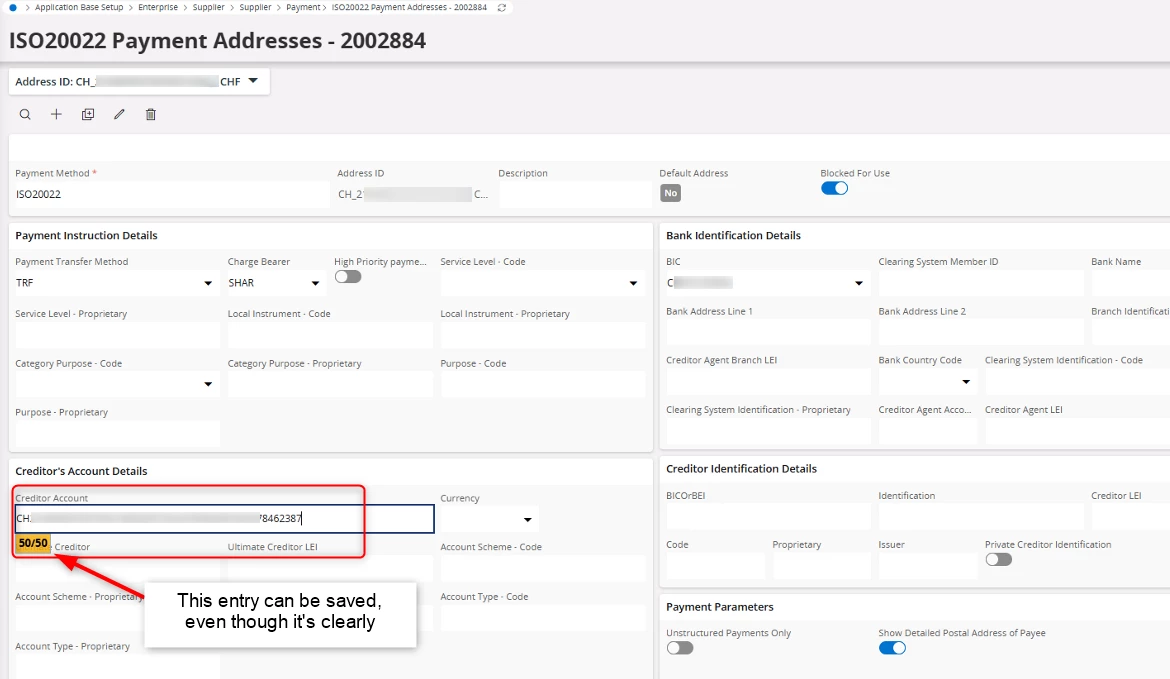
If such a faulty IBAN is later used in a supplier payment, the entire payment order fails with a generic error message:
(Error details: [{"code":6502,"message":"ORA-06502: PL/SQL: numeric or value error: character string buffer too small"}].
This requires additional troubleshooting to identify the wrong IBAN. Depending on the used process no IBAN is shown in the payment proposal itself (a quick report has to be used to identify the error).
Solution
Several solutions are possible. A toggle in the window “Payment Adresses” called “IBAN Validation” in the Creditor’s Account section could steer the validation. It should be turned on by default and, if activated, the entry in field “Creditor Account” should be validated against the entries in “IBAN Validation Information”.
By implementing this enhancement, we ensure that IBAN validation is consistently applied throughout the system. This reduces the risk of incorrect financial data, avoids unnecessary troubleshooting efforts, and improves overall data integrity.